
1.Where the book opens
On 28 January 2019, P.C. Mohanan and J.V. Meenakshi resigned from the National Statistical Commission. An employment survey the commission had approved in December sat unreleased. Three days later a newspaper printed the survey's central finding, an unemployment rate of 6.1 per cent, the highest a national sample survey had recorded since 1972–73. A union minister said there was no such report. On 31 May 2019, eight days after the results of a general election were declared, the government released the report. The number in it was the number the newspaper had printed in January.
Nobody, in the end, had quarrelled with the survey's design, its sample or its arithmetic. The whole fight had been over custody. It was about who owned the number, and when, if at all, the public that had answered the surveyors' questions would be permitted to see what its answers added up to. The book opens with that episode, and with the eight decades of decisions that built the machinery of custody, worked it, and have lately been unmaking it.
2.The argument
A statistic presents itself as a fact about the world. It is more accurately the residue of a chain of decisions: that a thing is worth counting; how the thing is to be defined; who will count it, on what budget and with what training; and when, whether and in what form the result will reach the public. Every link in that chain is forged inside an institution, by people who answer to other people, and every link can be made in good faith or with an eye to advantage. The history of a country's official numbers is for that reason a branch of its political history, and it is as political history that the book tells it.
Independent India built, between 1947 and the late 1970s, a statistical system of unusual ambition for a poor country, designed to serve a planning state that wished to know its economy in order to direct it. That system was rebuilt after 1991 to serve the market and its watchers, and rebuilt again after 2004 to serve citizens who had acquired legal rights to information and to employment and needed numbers to enforce them. From 2009 the state assembled a digital apparatus that counted people continuously, one authentication at a time, and from roughly 2015 the numbers themselves became objects of open political contest. The title names the mechanism, which works as Figure 1 sets out.
The argument makes no claim of conspiracy and requires none. The decisions the book records were taken by identifiable bodies for reasons that were usually stated and sometimes even good. The founders' system had blindnesses of its own, the invisibility of women's work above all, so there was no golden age to fall from. The book proceeds from a stated position, that official statistics a government cannot suppress belong to the same class of institutions as courts a government cannot instruct, and that their weakening is a public loss whichever party presides over it.
3.Plan of the book
The book is arranged in thirteen chapters across five parts, with a conclusion, and runs from 1947 to 2027, ending with the census now scheduled for that year. Each chapter makes one argument. The five periods overlap at their edges, and the introduction defends those breaks as they stand. Table 1 gives the plan; the summaries orient the reader and do not stand in for the text.
| No. | Chapter | Subject |
|---|---|---|
| Part I. Foundations (1947 onward) | ||
| 1 | A State Learns to Count | What the new republic inherited from colonial enumeration, what Mahalanobis and a small circle built between 1949 and 1951, and whose work the definitions could not see. Gender enters here, with the 1940 report on Woman's Role in Planned Economy and the 1974 audit Towards Equality. |
| 2 | First Principles | What measurement does to a state and to the measured, from Domesday and political arithmetic through Goodhart, Kuznets and Hacking, including how hijra and transgender people were registered and counted from the Criminal Tribes Act of 1871 to the plans for the census of 2027, and ending with the Indian Constitution, which makes the count itself an allocation of power. The chapter also states the book’s three mechanisms. |
| Part II. The Market Turn (1991 to 2004) | ||
| 3 | Opening Markets | After 1991 the state ceased to be the economy's director and became one of its performers, watched by lenders, investors and rating agencies; the chapter follows its dealings with the World Bank and the IMF, first resisted and then accommodated. |
| 4 | The Infrastructure Obsession | How built assets became the favoured proxy for progress, and what the proxy missed. |
| Part III. Rights and Audit (2004 to 2014) | ||
| 5 | Rights, Audits and Transparency | The Right to Information, social audit under NREGA, and the first use of budget and tax figures in claims about rights. Aruna Roy, Nikhil Dey and Jean Drèze appear as documented actors beside the official record. |
| 6 | From Rights to Services | The move from guaranteeing entitlements to delivering services, and what the shift changed in the way the state measured its own performance. |
| Part IV. The Digital State (2009 to 2020) | ||
| 7 | Aadhaar and the Digital State | Identification made continuous rather than decennial, welfare made conditional on authentication, and the exclusions that followed when authentication failed, set down with care for the evidence on both sides. |
| 8 | The Experimental Turn | The rise of randomised trials and the spread of evaluation, up to the 2019 economics Nobel awarded to Banerjee, Duflo and Kremer, treated on the method's own terms. |
| 9 | The Under-Counted: Gender, Health and Environment | The fields the dashboards weighed lightly: women's unpaid work and the measurement of their labour, health data through the COVID-19 years, and the environment. The gender thread opened in Chapter 1 is gathered here. |
| Part V. The Contested Present (2020 to 2027) | ||
| 10 | Contested Numbers at Home | The GDP base-year revision and the back-series, the disputes over the poverty line, and the data withheld or released late, anchored in the resignations of January 2019 and dated and sourced throughout. |
| 11 | India in the Global Mirror | The global rankings India courts or attacks depending on the result, read against China. |
| 12 | Governing by Algorithm | The algorithmic decision systems of the 2020s that purged welfare rolls, and the private vendors whose code sits beyond the reach of the Right to Information. |
| 13 | Counting Citizens | The census of 2027, the first caste count since 1931, and the delimitation that must follow, with its consequences for the federal balance. |
| · | Conclusion | Which numbers reach the public, and which ought to. |
4.Method and sources
The book is an interpretive institutional history. Its materials are the public record: the reports of committees and commissions from the National Planning Committee onwards; the Gazette of India; questions and replies in Parliament; the survey reports of the NSS and its successors, whose prefaces and appendices often say more than their tables; the minutes of public bodies where these are available; the contemporary press; the memoirs and interviews of participants; institutional archives where accessible; and the secondary scholarship.
Where the book states that something happened, a dated document or a named person says so in the notes. Where it reports what someone intended, it is because that person, or a document they signed, stated the intention; motives are otherwise left to the reader. Where the record is disputed, the versions are given with their sources, and the dispute itself is treated as part of the history. The book is neither econometrics nor ethnography. It produces no new estimates, claims no fieldwork, and where technical controversies arise it reports the positions of the qualified and does not pretend to referee them.
Appendix.Chronology, 1931 to 2027
A selection of dated events from the record the book assembles, arranged by its five parts. Every date below carries a source in the book's notes.
Part I · Foundations
Part II · The Market Turn
Part III · Rights & Audit
Part IV · The Digital State
Part V · The Contested Present
| Date | Event |
|---|---|
| Part I. Foundations | |
| December 1931 | P.C. Mahalanobis founds the Indian Statistical Institute in Calcutta. |
| 1940 | The National Planning Committee's sub-committee on Woman's Role in Planned Economy, under Rani Lakshmibai Rajwade with Mridula Sarabhai as member-secretary, demands that household work be counted as work. The report is published only in July 1947, and filed. |
| 1943 to 1945 | Famine kills between one and a half and three million people in Bengal, the range itself a measure of the failure of colonial registration; the Indian Statistical Institute's sample survey of the famine's after-effects supplies the most rigorous count. |
| January 1949 | Mahalanobis is appointed Honorary Statistical Adviser to the Cabinet; the National Income Committee follows in August 1949. |
| October 1950 | The first National Sample Survey round enters the villages, a permanent scientifically designed household survey without precedent in a newly independent country. |
| February 1951 | The first census of the republic returns 361 million people and a literacy rate of 18.3 per cent; caste is dropped from the schedules, except for the Scheduled Castes and Scheduled Tribes. The Central Statistical Organisation is set up the same year. |
| 1962 | A Planning Commission Working Group fixes the poverty line at Rs 20 rural and Rs 25 urban per head per month at 1960–61 prices, with health and education deliberately excluded on the stated ground that the state would provide both. |
| January 1971 | Dandekar and Rath publish Poverty in India, defining the poor by a calorie anchor of 2,250 a day and finding about 40 per cent of rural India below it, on twenty years of NSS consumption rounds. |
| 31 December 1974 | Towards Equality, the first full audit of Indian measurement conducted by its subjects, is presented. It documents a sex ratio that had fallen at almost every census since 1901 and women's recorded work shrinking partly by definition. |
| 1976 | The Constitution (Forty-second Amendment) Act freezes the allocation of Lok Sabha seats among the states at the population of 1971; the Eighty-fourth Amendment of 2001 extends the freeze until the first census after 2026. |
| Part II. The Market Turn | |
| July 1991 | The crisis and the reforms change the audience for Indian numbers. Growth rates, deficits and reserves displace physical targets at the centre of official attention. |
| 19 January 2000 | The Rangarajan Commission, a review of the statistical system under C. Rangarajan, is constituted; it reports in August 2001, recommending among other things a statutory National Statistical Commission. The statute never came. |
| Part III. Rights and Audit | |
| 15 June 2005 | The Right to Information Act receives assent; the National Rural Employment Guarantee Act follows on 5 September 2005, with social audit written into its seventeenth section. |
| 12 July 2006 | The National Statistical Commission is constituted, under a government resolution of 1 June 2005, without the statute the Rangarajan Commission had asked for. |
| Part IV. The Digital State | |
| 28 January 2009 | The Unique Identification Authority of India is constituted by government notification. |
| 29 September 2010 | The first Aadhaar number is issued, to Ranjana Sonawane of Tembhli village, Maharashtra; identification becomes continuous rather than decennial. |
| 14 October 2019 | The Sveriges Riksbank Prize in Economic Sciences goes to Banerjee, Duflo and Kremer for the experimental approach to alleviating global poverty. |
| Part V. The Contested Present | |
| 30 January 2015 | A new GDP series with base year 2011–12 is released; the back-series of 28 November 2018 is presented to the press at NITI Aayog rather than released by the statistics ministry. |
| 28 January 2019 | Mohanan and Meenakshi resign from the National Statistical Commission over the unreleased employment survey the commission had approved in December 2018. |
| 31 May 2019 | The Periodic Labour Force Survey for 2017–18 is released, eight days after the election results; the unemployment rate in it is 6.1 per cent, the number the Business Standard printed on 31 January. |
| 15 November 2019 | The Household Consumer Expenditure Survey of 2017–18, completed and examined, is set aside outright by a ministry press note. |
| 2021 | The census due that year is postponed when the pandemic arrives and stays postponed long after the pandemic has left; the mortality of the COVID-19 years becomes itself a contested estimate. |
| 28 September 2023 | The Constitution (One Hundred and Sixth Amendment) Act reserves a third of legislative seats for women, taking effect only after a delimitation based on the first census conducted after its commencement. |
| 30 April 2025 | The government announces that the forthcoming enumeration will record caste, which no Indian census has fully counted and published since 1931. |
| 16 June 2025 | Ministry of Home Affairs notification S.O. 2681(E) declares under the Census Act, 1948 that a census will be taken in 2027, superseding the notification of March 2019 for the census that never happened. |
| 1 March 2027 | The reference date for the census of 2027, the sixteenth count since 1872 and the first in sixteen years. Seats, safeguards and money all move when the count moves; the book ends here. |
↓ Download the chronology as CSV·use your browser’s Print → Save as PDF for the full page.
Note: Dates and particulars follow the book's introduction and opening chapters, where each carries its source.
·Three series from the book
Three of the book’s claims, drawn as series. Each is built from public data, with the source given in the caption; the figures illustrate the argument and do not replace it.
Enrolment and reading
Enrolment of children aged 6–14 has held near 96–98 per cent for more than a decade. Whether those children can read has moved on a track of its own.
The census sex ratio
The measure Towards Equality read as an indictment in 1974. Women were returned in smaller numbers at almost every census to 1971, the fall part real and part an artefact of how work and the household were defined.
The poverty headcount
One official series, on the Tendulkar methodology. Where the poverty line is drawn, and by whom, is itself the argument the book follows.
·Where the book sits
A map of the scholarly field the book joins, grouped in four strands. The works below were researched for this page and are given with their sources; the book’s own notes remain the authoritative bibliography. A ▸ marks a work the book engages directly.
1 · Quantification & authority
How number became the language of objective, governable knowledge, the tradition the book writes within.
- Theodore M. Porter, Trust in Numbers: The Pursuit of Objectivity in Science and Public Life (1995)
- Alain Desrosières, The Politics of Large Numbers: A History of Statistical Reasoning (1998)
- ▸Ian Hacking, The Taming of Chance (1990)
- James C. Scott, Seeing Like a State (1998)
- Wendy Espeland & Mitchell Stevens, “A Sociology of Quantification” (2008)
- Sally Engle Merry, The Seductions of Quantification (2016)
2 · When a measure becomes a target
The corruption of measures used as targets. This is the first mechanism in Figure 1, and the strand the book cites by name.
- ▸Charles Goodhart (1975), on Goodhart’s law
- ▸Donald T. Campbell (1979), on Campbell’s law
- ▸Marilyn Strathern, “‘Improving ratings’: audit in the British University system” (1997)
- Michael Power, The Audit Society (1997)
- Jerry Z. Muller, The Tyranny of Metrics (2018)
3 · Counting India, colony to republic
How enumeration made and remade Indian society, from the colonial census to the planning state, the history the book extends.
- Bernard S. Cohn, “The Census, Social Structure and Objectification in South Asia” (1987)
- Arjun Appadurai, “Number in the Colonial Imagination” (1993)
- Nikhil Menon, Planning Democracy: Modern India’s Quest for Development (2022)
4 · Measuring Indian development
The measurement debates the book narrates: poverty lines, women’s work, and the experimental turn.
- ▸V. M. Dandekar & Nilakantha Rath, Poverty in India (1971)
- ▸Committee on the Status of Women in India, Towards Equality (1974)
- Amartya Sen, “Missing Women” (1992) and the capability approach
- Angus Deaton & Valerie Kozel, The Great Indian Poverty Debate (2005)
- Jean Drèze & Amartya Sen, An Uncertain Glory: India and Its Contradictions (2013)
- ▸Banerjee, Duflo & Kremer, the experimental turn (2019 Nobel)
·About the author

·Publication details
- Title
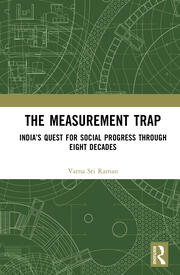
- The Measurement Trap: India's Quest for Social Progress Through Eight Decades
- Author
- Varna Sri Raman
- Foreword
- Aruna Roy and Nikhil Dey
- Publisher
- Routledge
- Edition
- First edition, hardback
- Publication
- March 2027
- Extent
- 284 pages with 35 black-and-white illustrations; thirteen chapters in five parts, with a conclusion
- ISBN
- 9781041436744
- Order
- Pre-orders open on 5 March 2027 on the book’s page at Routledge
- Status
- Final manuscript submitted to Routledge on 15 September 2026; corrected files sent on 17 October 2026. Listed by Routledge as forthcoming.
Where the book is
- November 2026Routledge listed the book with its ISBN, 9781041436744, a March 2027 publication date and a cover. Pre-orders open on 5 March 2027.
- October 2026Corrected files went to Routledge on 17 October. A first excerpt, from Chapter 5, appeared in Mainstream on 22 October and is reproduced on the excerpts page. The book is in editorial preparation, and copyediting follows.
- September 2026The final manuscript, thirteen chapters in five parts with a conclusion, went to Routledge on 15 September.
- July 2026This companion page went up, with the chronology, the figures and the reading list.
Cite this book
Sri Raman, Varna. The Measurement Trap: India’s Quest for Social Progress Through Eight Decades. London: Routledge, 2027. ISBN 9781041436744.
@book{SriRaman_MeasurementTrap,
  author    = {Sri Raman, Varna},
  title     = {The Measurement Trap: India's Quest for Social Progress Through Eight Decades},
  publisher = {Routledge},
  address   = {London},
  year      = {2027},
  isbn      = {9781041436744}
}
Provisional. The year, ISBN and page count follow Routledge's listing and may change before publication.
This page is a companion to the book, built for readers, students, journalists and policy audiences. It offers orientation and chronology; it does not reproduce the manuscript. The log above is where the state of the book is recorded. Contact details for rights, review copies and speaking enquiries will be added when Routledge confirms them.
·Advance praise
Politics and public life
“In The Measurement Trap, Varna Sri Raman offers a compelling and meticulously researched account of India’s fraught relationship with the statistics by which it governs itself. Drawing on eight decades of India’s experience, she reveals how an impressive statistical apparatus, conceived to illuminate the nation’s progress, has increasingly become vulnerable to the political interests it was meant to hold accountable. The book raises questions that go to the very heart of democratic governance, reminding us that numbers are never merely numbers: they are instruments of power, whose credibility is indispensable to public accountability.”
— Shashi Tharoor, Member of Parliament (Lok Sabha) for Thiruvananthapuram & Chairman, Parliamentary Standing Committee on External Affairs
“The great irony of the modern information era is that richer the information, poorer is our society. There seems to be just enough information for every small section of society to claim their view, causing friction with others.
In this context, it is very welcome that this book takes us back to the basics - what is measured, what is reported, what is hidden, what is left behind.
A fabulous, diligent effort of calm amidst the torrent of data noise.”
— Praveen Chakravarty, Member of Parliament (Rajya Sabha) for Tamil Nadu
“Having worked closely on electoral roll analysis in Bihar and Telangana, I have seen how decisions about data can directly affect citizens’ rights and democratic representation. The Measurement Trap powerfully demonstrates that the question is not merely whether governments count accurately, but who controls the numbers, what remains uncounted, and whether citizens can challenge the results.
Varna Sri Raman makes a compelling case that independent, transparent and accountable public statistics are not merely good governance; they are essential safeguards of democracy.”
— Syed Khalid Saifullah, President, Hyderabad District Congress Committee; Vice Chairman, AICC Technology & Data Cell
Journalists and media
“Two major achievements of governments have been, first, successfully raising the Hindu-Muslim bogey and, second and even more significant, the fudging of data. Data is sacred for any nation and more so for a developing country where each count from the community and caste numbers to the wealth divide is meant to tell the story of the real progress the nation has made. And governments have achieved this feat successfully. It is creditable of Varna Sri Raman to have researched well to expose the myth of India’s progress by sifting the real data.”
— Faraz Ahmad, Senior Journalist & Author of An Inside Job: Assassination of Rajiv Gandhi
“The Measurement Trap makes for extraordinary reading: crisp, sharp, steady. Varna Sri Raman has a rare talent for threading tiny details into the big picture, in-out, in-out, her canvas engagingly telling the political story of India’s mighty machinery to count and survey. Her neat labels, painstaking detail, intense categorising and easy recounting draw the reader in, and show her grasp of the day’s politics as they shaped ‘the measured, the unmeasured, and the unwelcome’. It takes a ‘millennial’ author to capture so acutely the gaps in measurement from the very beginning, women’s unpaid work for one. The book’s feminist spine brings measurement’s many moving parts since independence together, closing with the soon-expected caste census. The Measurement Trap will count as a welcome addition to literature on India’s political history.”
— Nandita Sengupta, Senior Editor, The Times of India
“In India, women’s work, women’s deaths and the air women breathe have been counted badly, late or not at all. The Measurement Trap shows that these gaps are a design problem. Varna Sri Raman writes with clarity and rigour on what the state misses and makes a compelling case for better statistics for better outcomes.”
— Bhanupriya Rao, Founder, BehanBox
Transparency and rights movement
“The Measurement Trap has enriched my understanding, and replaced my preoccupation with a book I read in my teens called, “How to lie with statistics”. The book demonstrates just how data can be used to destroy and build arguments. The Measurement Trap is a far more comprehensive treatise on data and statistics and the politics that affect the process. It is a fascinating contemporary analysis explaining how the mechanism of collection and storage of data has become one of the most critical means to control centres of power. Data and statistics allow the abuse of probity and power, and help it to don the false dignity of veracity. India has seen civic action questioning the hypotheses of such claims, and establishing that law and practice have to change. Varna Sri Raman documents and analyses the centres of people’s resistance as well.
This book makes a strong argument of why and how the controls over data, in a democracy should lie with affected people. It meticulously explains how it is factored into a powerful tool in the power game of controls, and economic and political dominance. Technology and on-line data have become an apparatus to store information and its use and mis-use in the inaccessible clouds of our computers and our conscience, hiding lies and more dangerously half-truths. Data is often cloaked as objective scientific data, but like all that is technical, it engages with and obeys its master, and the ideology that informs its framework. The book brings popular movements also into its argument to claim that data, after all, should be most available to the people whom it describes; who will act as verifiers and users.
Any struggle for information, accountability, and for responsible governance has to deal today with understanding data, its role, and its controls. A must read for anyone concerned with probity in public life.”
— Aruna Roy, Founder, Mazdoor Kisan Shakti Sangathan (MKSS)
“In the early 1990s, 50 year old Mohan Ram - a dalit singer with the MKSS who had never been to school, spontaneously composed two lines of a song we have revisited many times to help us understand where and why we started demanding copies of official records. The song called "Raj Choron Ka " ( Thieves rule us)
had one stanza that threw light on how the poor are controlled and exploited through written records -
"pahle wale chor, bandookon se maarte the;
Aaj kal ke chor, kalmon se maarte hain
-Raj choron ka!"..( the thieves of the past killed us with guns –
the thieves of today, kill us with the pen!
Thieves rule us!)Ten years later, an MKSS handbill (parcha) distributed during one of its pioneering jan sunwais, articulated the demand for the right to information "Because everyone wants to know the truth". This straightforward justification drew people’s support for the demand for access to records, and public audits - where people would have the right to verify critical public records.
This delightful book explores multiple dimensions of the same continuum, of the search for truth; within, and related to official records.
The celebrated RTI movement in India, owes it’s origins to the struggles of people who had only been seen as uneducated, passive recipients of policies created by a ruling elite. Suddenly, they were prying open accounts, records, data, statistics, reports, evaluations and measurements. This was done with creativity and doggedness, exposing their own exploitation and shaping a legal entitlement that would take away the levers of power from their elite rulers, using information as a tool. Once the basic relationship is altered, the questions never cease.
‘The Measurement Trap’ follows a very different path to perceptively chronicle the story of how rulers seek to use data and information to control the lives of people, and shape the narratives around them. Every figure, digit, number, classification of data and information, is coloured by the political economy of the times it lives in. This book reveals, how the kinds of measurement records of a political era, can tell us a lot about the nature of the rulers of those times. In an engaging and enquiring manner, it helps us understand the deliberate twists and turns of measuring ‘development’ and democracy.
This is a book that must be read by academics, policy makers, activists, political leaders, and grass root practitioners. It might take our comrades in rural Rajasthan a while to understand that the "Measurement trap" is not a reference to the "measurement book" they fought to access many years ago. But they do understand the ‘trap’ of all measurement systems - particularly when they are controlled by those who rule. And Varna Sri Raman, recognises the fundamental shift that takes place when the people become the evaluators. In the Chapter on Rights, Audits, and Transparency, Varna points out that the ‘drain theory’ of Dadabhai Naoroji, had predicted how “the ruler’s records, once in the subject’s hands, can be turned against the ruler.” But she puts her finger on the paradigm shift, when the records were read aloud in Jan Sunwais “before the people whose names the accounts bore, and let the crowd say whether the paper spoke true.” The people not only got access to information, but forged an opportunity to set the narrative.
Eventually this book helps us understand the multiple ways in which rulers and their agents use , misuse , and disuse data to manipulate measurements to conceal the truth. It is therefore also an expose - an RTI story, on how the (Indian) ruling class seeks to perpetuate its power through its use of data. The book is educative and entertaining at the same time. Mohanji would have loved to turn it to verse and song, not for the classroom - but for the people and their struggles for change.”
— Nikhil Dey, Founding member, Mazdoor Kisan Shakti Sangathan (MKSS)
“The Measurement Trap shows that every census, survey and database is also a decision about who the state will see and those who get left out. Tracing India’s counting from the colonial census to Aadhaar and algorithmic welfare, Varna Sri Raman keeps the ordinary person who is part of a statistic or a sheet as the primary subject. This includes families denied rations when a fingerprint fails to match, and workers whose job cards were deleted in bulk. A necessary book for anyone who assumes that more data makes for better government. We are more than what we measure.”
— Apar Gupta, Founder Director, Internet Freedom Foundation
Academics and educators
“As ordinary but concerned citizens, it is hard to appreciate how much data and the state’s statistical machinery matter in our everyday lives, and therefore for our democracy’s health. The Measurement Trap helps readers see that it is not a bookish issue, but a matter of public concern.”
— Reetika Khera, Professor of Economics, IIT Delhi
“Official numbers are given and cited as answers; this book teaches the reader to ask the questions that restore their context: what was counted, by whom, to what purpose, and who saw the result first. Varna Sri Raman’s history of India’s official numbers is, at its heart, a masterclass in asking them. It should be essential reading for students of public policy, and for anyone who forms a diagnosis or prescription from secondary data.”
— J. Mathew (Jojo) George, Director, St Mary’s College, Hyderabad & Group COO, Marian Educational Initiatives
Peer reviewers
“Original, timely, analytically rich, and potentially significant for development studies, political economy, governance studies, and the sociology of statistics.”
— Anonymous peer reviewer of the book proposal, for Routledge
“The language is sophisticated, fluent, and highly readable. The prose demonstrates intellectual maturity and strong command over academic and policy discourse.”
— Anonymous peer reviewer of the book proposal, for Routledge
“This is a unique proposal, and work of this kind in such comprehensive manner is absent in contemporary comparable literature.”
— Anonymous peer reviewer of the book proposal, for Routledge
“The book … would be a very important contribution to a literature that is rare in terms of its importance of documenting the process from a critical and technical lens.”
— Anonymous peer reviewer of the book proposal, for Routledge
The four peer reviewer excerpts are taken from the anonymous reviews of the book proposal that Routledge commissioned.
·Complementary resources
Interactive data tools by the author on related subjects.
- India Development Indicators GDP, life expectancy, literacy, electricity, internet and CO₂ on live World Bank data, with a state-wise HDI ranking and policy timeline.
- How India Lives 205 state-level maps across demography, health, gender, economy, education and environment. They show why India’s states differ, and why it matters for policy.
- SDG Progress Tracker India’s progress on all 17 Sustainable Development Goals, with year-on-year trends and a flow of on-track, stagnating and off-track outcomes.
- Some Perspective Data-driven analysis of India’s political economy, covering policy impact, fiscal trends and governance indicators with interactive visualisations.
Contact. Varna Sri Raman · @varna. Enquiries about rights, review copies and speaking will be listed here on publication.